EXOTIC PROCESS
HOW MUCH COFFEE DOES MEXICO GROW?
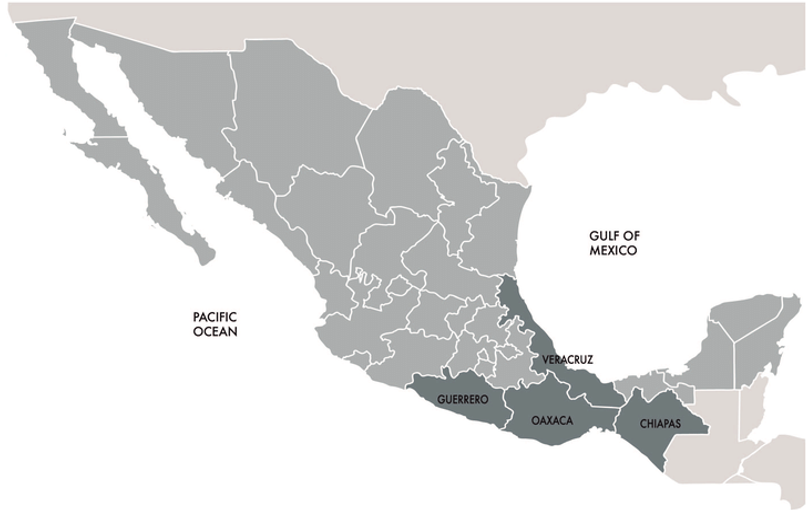
The crop is grown across 16 of Mexico’s states, but you will find most of the country’s 711,000 hectares (as of 2018) in the south.
A little-known fact is that Mexico is one of the world’s largest exporters of organic-certified coffee, with up to 8% of producers growing it, according to the Department of Agriculture.
THE TYPICAL MEXICAN COFFEE
Mexico grows mostly shade-grown Arabica coffee, with Robusta making up only 3–4% of the country’s crops. 35% of Mexico’s coffee is grown at 900 m.a.s.l., conditions that – in Mexico’s relatively cooler climate – are favourable for higher-quality coffees.
Yet while there is little variation in processing methods according to the region, you will find striking differences in the coffees’ sensory profiles and the producers’ cultivation practices.
MEXICO’S 3 MAJOR COFFEE REGIONS
VERACRUZ
Caressing the Gulf of Mexico is the long thin state of Veracruz. It can boast of being the first Mexican state in Mexico to see a coffee tree planted in its soil, back in the 18th century.
CHIAPAS
Nestled on the Guatemalan border, you’ll find the state’s best coffees growing between 1,300 and 1,700 m.a.s.l. Chiapas also holds the crown for producing the most coffee in Mexico, at 40% of the country’s total yield.
OAXACA
Slotting in as neatly as a jigsaw piece, Oaxaca borders the bottom of Veracruz and the top of Chiapas, while the Pacific Ocean sits to its west. Its coffee farms are generally between 900 and 1,650 m.a.s.l.